Monday, August 26, 2013

Poetry Trading Cards

Back in the day, when the differences between Topps, Fleer, and Donruss baseball cards were crucial distinctions for some of us in the P&PC Office, and when were happy to do nothing more than spend hours and hours ordering, reordering, and moving our card collections from one government cheese box to another, a prize of any collection was the tobacco card—the slightly-bigger-than-a-9-volt-battery-sized card, usually from 1909 or 1910, usually with corners rounded from age and handling if not stints in between the spokes of some boy's bike, and originally given away for free with tobacco products.

We all held such cards with reverence, storing them—if we could somehow get our hands on them—between heavy, inflexible pieces of transparent plastic. Not only were they old, but each one tangibly linked us to the story of the T-206 Honus Wagner (pictured here): how the Hall of Fame Pittsburgh Pirate shortstop refused to lend his visage to the tobacco industry, how he righteously demanded that the American Tobacco Company recall all of his cards, and how the few cards that managed to sneak into circulation (some estimate between 50 and 200) went on to become the most rare, famous, and valuable cards in history (one card recently sold for $2.8 million). Every dusty box we came across in every attic or barn was, we never ceased believing, full of abandoned, mint condition tobacco cards. And among those cards was, we were certain, the T-206 Wagner.

Nowadays, when we think of them, those imaginary dusty boxes are more likely full of old books (especially an 1855 edition of Leaves of Grass) than they are baseball cards, but more likely than either of those scenarios is that we might come across something like a mixture between the two: like, for example, the set of 54 "Camera Studies" trading cards produced in 1926 by the British cigarette manufacturer Cavanders Ltd. and pictured here. What's remarkable about these cards is not the full and complete set that we have in our possession, nor the excellent condition they're in, but how each card features a scene from the British countryside on front and—wait for it—a quotation from a famous poet on the back.

Originally based in Manchester, Cavanders was founded in 1775 and lasted until 1961 when it was taken over by the Godfrey Philips cigarette company whose main factory is now in Mumbai. For a time in the early twentieth century, Cavanders was the UK's largest supplier of cigarette cards, issuing forty-one different series including a set of miniature stereoview cards complete with a Camerascope for viewing them. The "Camera Studies" poem series features handpainted photos—which means that every card is unique (think of all the labor that went into that)—paired with quotations on back related to the respective cards' subject matter. There's Shakespeare, Spencer, Shelley, Byron, Keats, Tennyson, Wordsworth, Herrick and others. All are British, with a heavy representation of the Romantics, except for two cards that include Longfellow. The quotations are predominantly classic; Swinburne and Rupert Brooke are the only two authors in the set who lived into the twentieth century.

One card captioned "The Placid Stream," for example (pictured here), features a babbling brook paired with an excerpt from Shelley's "A Dream of the Unknown" (image below):

And nearer to the river's trembling edge,
There grew broad flag-flowers, purple prank with white.

Our quick Google searches don't turn up much on Cavanders, let alone anything about how many of these cards were eventually issued or how they were used: Were they traded? Collected in albums like American advertising cards were? Shared by cigarette-smoking men with their wives and children the way cigarette-smoking American men gave tobacco baseball cards to their kids? Is it possible that, in some British clubs, groups of men poured each other brandies, lit up together, and read the poems aloud? Is it possible that they swapped verses hoping to compile a complete set of their own? (Now that's something we want to see on Downton Abbey!)

We suspect that someone out there could make some interesting arguments about how these cards affected the place of the Romantics—if not poetry in general—in the cultural imagination, as they so closely link Shelley, Wordsworth, et al. with nature and not those authors' radical politics or social concerns. We also think there's something to be said for how Cavanders appealed to almost "timeless" pastoral and agricultural scenes immediately following World War I; the presence of Brooke, who was killed in the war, suggests that these cards may on some level be treating or at least responding to a national trauma by looking backward in time. But as the P&PC Board of Directors hasn't yet approved the addition of a British poetry specialist to our office of Americanists, we can't say for sure.

What we do know, however, is that you don't need a Honus Wagner T-206-like $2.8 mill to get your paws on a set of cards like these. Nor do you have to go searching your attic for an abandoned dusty box. Nope. We checked around in some price books and collector sites online, and the "Camera Studies" series is a lot more affordable. If you head over to eBay today, for example, you can in fact find individual cards listed for less than three bucks a pop (or best offer) as well as a listing for a complete set with a starting minimum bid of U.S. $2.32. Happy bidding.

Saturday, August 17, 2013

'Tis the Last Rose of Summer: LARC at WU

Folks in the P&PC Office have spent a good portion of the last two weeks revving up for the school year: we've been buying new magic markers, trying on the latest hip jeans and gym shoes, putting together our Trapper Keepers, designing syllabi for two classes focusing on the poetry of Walt Whitman, and wistfully reflecting on Thomas Moore's "last rose of summer / left blooming alone." School starts next week, and we're excited—don't get us wrong. But we also don't want to leave summer, because leaving summer means leaving our LARC summer research team—a grant-funded group of three Willamette faculty and four Willamette students who have been working independently and collaboratively on projects related to "The Age of Projection: Remediation, Reformation, and Revolution."

Every summer for three or four years now, Willamette University's Mellon-funded LARC (Liberal Arts Research Collaborative) program has been making it possible for faculty and students to do collaborative, interdisciplinary research in the humanities. Set up in part to discover potential models for humanities-based student-teacher research at small undergraduate universities, LARC provides funds for students (living space for the summer plus a stipend) and faculty to work in teams on proposed projects. And this year P&PC got a chance to take part. Along with Abigail Susik (Art History), Anna Cox (Spanish and Film Studies), and four students (Andrea Adachi, Hannah Brown, Emma Jonas, and Amy Snodgrass), we pursued projects based in some way on how projection- and other screen-based media affected literature, art, film, politics, and graffiti over the course of the twentieth century. (See our proposal and five others here.)

So what did we all do? Well, P&PC pursued its current fascination with the projection of poetry via magic lantern at the turn of the century—the first time in history, we believe, when people began to commonly experience reading as something that happens off of the handwritten or printed material page. (See a couple of our past postings on the subject here and here; that's an example of a lantern poetry slide pictured just above.) For us, this moment not only sets in motion an age of screen reading leading up to the computer and e-reader, but it also gives us a historical starting point to help nuance our discussions about the "death of print." As it turns out, the hegemony of print reading was coming under pressure long before digital media, and the fact that poetry—popular poetry, natch—was central to this phenomenon makes us rethink (for one) the roles poetry played in the development of modern life and (two) how poetry scholars might do well to better account for the proliferation of poetry in non-print media formats over the course of the twentieth century.

For their part, Abigail and Emma both studied the incorporation of projection into contemporary new media art and graffiti practices (they even attended the Elektra International Digital Arts Festival in Montreal); Anna and Hannah studied the aesthetic and political pressures that Spanish filmmakers faced under Franco's dictatorship (Hannah spent time in the Basque country for part of her project); and Andrea sort of partnered with all of us as she studied how the ephemeral poetic graffiti of Quito, Ecuador (such as the example pictured here) has found an unexpected permanence or afterlife via preservation and documentation online.

Just as Abigail worked closely with Emma, and Anna worked closely with Hannah, so P&PC worked especially closely with our seventh team member, Amy Snodgrass, who studied the the proliferation of new poetry reading and writing experiences enabled by digital and online media ranging from the programmed works of single authors to the group-generated haiku "discussions" of Craigslist. (Why someone hasn't yet written in a prominent way about the haiku "discussion forum" of every city's Craigslist is a wonder to us!) Check out some of the poems that Amy took as the initial objects of her study:

"Separation/Séparation" by Annie Abrahams
"Sooth" and other poems by David Johnston
"Soliloquy" by Kenneth Goldsmith
"The Sweet Old Etcetera," a set of e.e. cummings poems choreographed by Alison Clifford
"Toucher" by Serge Bourchardon, Kevin Carpentier, and Stephanie Spenle
"Fitting the Pattern" by Christine Wilks
"This is How You Will Die" by Jason Nelson

Our students will all be presenting their projects to the W.U. community this Fall, by which time summer will be mostly a distant image in the rear-view mirror. But make no mistake about it. Both our formal meetings and discussions (every member of the team led a three-hour group discussion about his or her research) and our informal gatherings and sharings were eye-opening, energizing, and inspiring, and we'll remember them and continue learning from them for a long time. Thank you, Mellon. Thank you, LARC administrators. And thank you, Abigail, Anna, Andrea, Emma, Hannah, and Amy. We loved every minute of it.

Monday, July 22, 2013

P&PC in NYC

P&PC just got back from a fantastic two-week stay in New York City. We rented an apartment in Windsor Terrace, Brooklyn, just across the street from Prospect Park and around the corner from friends living in the trendier and spendier Park Slope. With that as home base, we spent our time visiting, sightseeing, and eating with old friends, taking in museums (The Met, Whitney, and MOMA's PS1), seeing a Broadway show, going to a Yankees game, attending several concerts in Prospect Park including the New York Philharmonic, hitting some flea markets, and sampling what NY had to offer in the way of summertime brews. We hit all five boroughs, had great Puerto Rican food in the East Village, superb Shanghai-style dumplings in Chinatown, mouth-watering Jamaican food in Lefferts Gardens and the Bronx, and walked ourselves out of a new pair of shoes and nearly into a case of plantar fasciitis.

With the exception of a quick dash (that's us—dashing as always—pictured above) into the Public Library to check out and photograph old issues of Popular Poetry magazine (pictured here), we didn't set out to do much in the way of research. But, as always, the research came to us. Is it possible that New York is the city most saturated with poetry in America? Check out the following photos and make the call for yourself.

New York loves Emma Lazarus's 1883 poem "The New Colossus," and while the closest we could get to Liberty Island—where the poem appears on the base of the Statue of Liberty—was the Staten Island Ferry, we did walk past the Park Avenue Methodist Church on the Upper East Side, which is currently quoting the poem's most famous passage "Give me your tired, your poor, / your huddled masses yearning to breathe free" on the sign outside its door.

We also ran across a facsimile of the poem at the City Reliquary, where it's part of a Statue of Liberty display featuring probably more than a hundred kitschy souvenir versions of the Statue. If you haven't been to the quirky, eclectic, three-room museum in Williamsburg, make time in your schedule the next time you go hipster-spotting. There you'll find displays on the 1939 and 1964 World's Fairs, a famous New York barber (along with a photograph album of people whose hair he cut), the dancer Little Egypt who scandalized crowds at the Columbian Exposition, rocks and discarded chunks of buildings from around the city (like a cobblestone from Cobble Hill), and other curiosities curated with a reckless abandon. If you're as lucky as we were, you might even run into a taxi driver-poet.

We, however, didn't take any taxis, preferring to spend our limited allowance otherwise. Instead, we took the subway—one site of the well-known Poetry in Motion initiative coordinated by the Poetry Society of America. Not only are there poem-posters in select subway cars (we kept running into Mary Ruefle's "Voyager" on the F train), but some MetroCards have poems printed on back as well. (The one pictured here was saved for us by our friends in Park Slope.) We have to confess that, more than once on our underground trips around the city, you could have heard us reciting Ezra Pound's "In a Station of the Metro"—a fact that bewildered one of our friend's children who didn't so much as bat an eye when a South American pan flute band stepped on at one station, launched into a short vigorous performance, and departed at the next.

We also did a lot of cool-hunting—not because we're hipsters, but because the weather was hot and muggy, soaring at times into the mid-90s. And even there, the poetry led the way, as this board propped outside of the Bowery Coffee suggests:

We Can Cool You Down,
Get Rid of Your Frown,
And Give You A Smile
That Will Last A While.

Cool-hunting also led us to the Brooklyn Botanic Garden, where we took in the bonzai tree museum and wandered the shady grounds. There, we came across the building pictured to the left which welcomes visitors with two lines mounted above the front door:

He is happiest who hath power
To gather wisdom from a flower

In case you were wondering, the lines are by Mary Howitt (1799-1888), a British writer and translator who, according to Wiki, authored over 100 books by herself and with her husband.

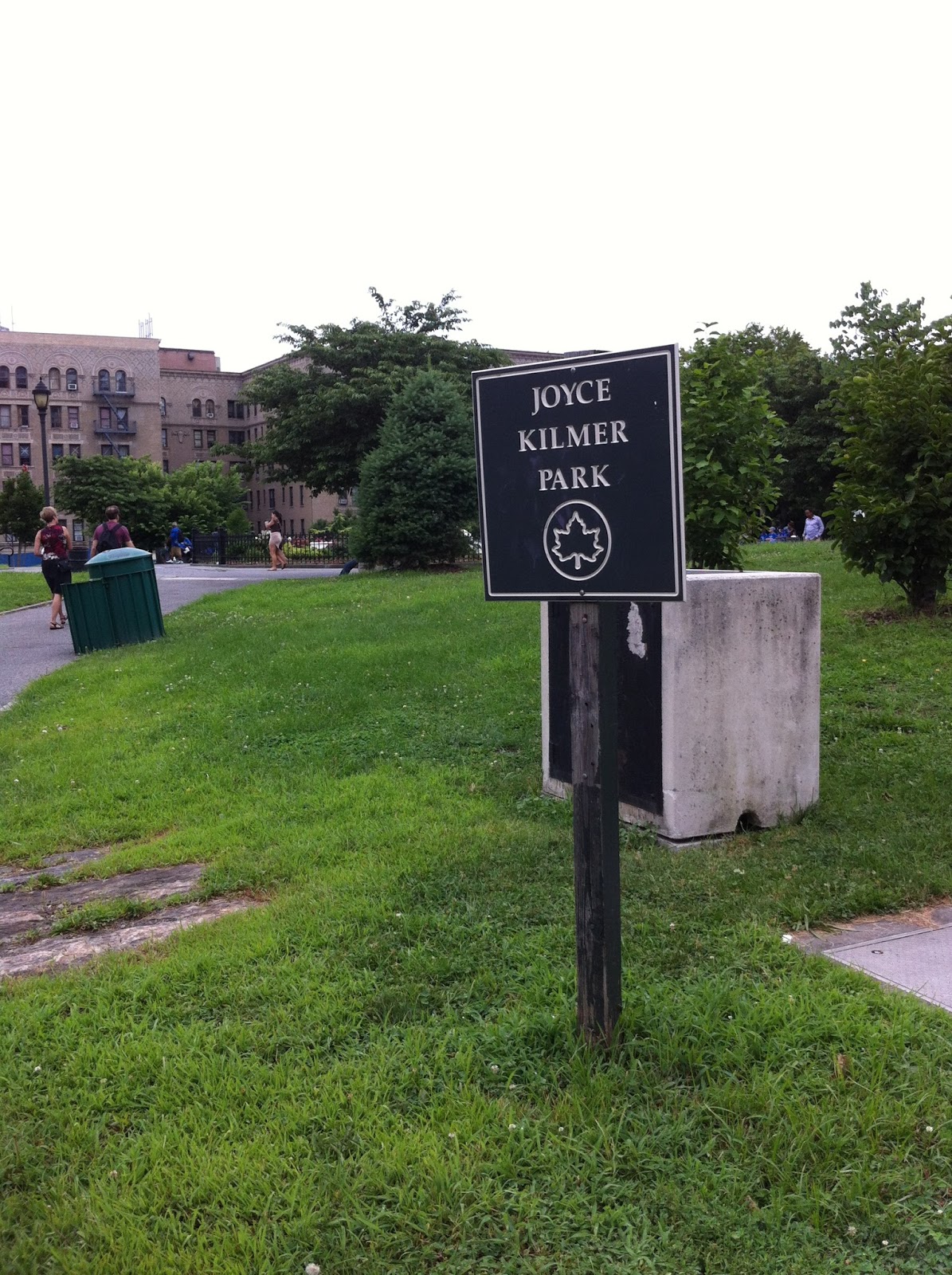
We're no fans of the Yankees, but we're fans of baseball, and so we took in a game at the new Yankee Stadium, stopping beforehand at Fauzia's Heavenly Delights food cart and taking our lunch to eat in Joyce Kilmer Park—named for the World War One-Era American poet, New Jersey native, and onetime Columbia College student. We searched and searched, and while we found a statue of Bronx civic leader Louis J. Heintz (as well as a rat nibbling on french fries and popcorn someone had strewn about), we couldn't find so much as a plaque about Kilmer himself. For a moment we wondered if the leaf design on the sign were a tribute to his famous poem "Trees"—a distillation of the poem to a single image—but then we realized with some dismay that, nope, it's just the logo used by the City of New York Parks & Recreation Department. Damn. The Yankees won as well.

So that's a recap of our time in the Big Apple. We walked the Brooklyn Bridge while quoting Hart Crane. We talked about Whitman with a guy running a flea market stall. And we began reading Catherine Robson's great new book Heart Beats: Everyday Life and the Memorized Poem. We've only been back in Oregon a week, but already our memories are fading—like the faces in a New York subway crowd, perhaps, or like petals on a wet, black bough.

Friday, July 12, 2013

P&PC at Five Years Old

There are streamers hanging from the walls, and silver helium balloons are floating around the P&PC Office today. The interns have their glittery, pointy birthday hats on, the entire P&PC Board of Directors is on hand strutting around with their hands in their vests like they've been the ones to make it all happen, and folks whose jobs have been outsourced or who have otherwise moved on to bigger and better things have come back to town. There's Polly the Paper Shredder. And there's Carl the Copy Guy. And is that really Sally the Stenographer? We love the new look. 

Today, P&PC turns five years old.

Who would've thought, back in 2008 when P&PC started up in Iowa City, that—more than 300 postings later—we'd still be around in 2013? That we'd bring on interns and a bunch of puffed-up suits to serve as our Board of Directors? That we'd move home offices from Iowa to Oregon? That more than 142,000 unique visitors would have found us on the inter-webs? That our most popular postings would be about zombie haiku and the poetry of G.I. Jane, The Expendables, The Grey, geocaching, and Craigslist. Back then, we were "just a blog"; today, doing pretty much the same thing we were doing five years ago, we are sometimes cited as an example of "digital humanities" in action. We've gotten shout outs in dissertations and the London Review of Books. We've been approached by fans at conferences. And we've reminded people that Everyday Reading: Poetry and Popular Culture in Modern America is available for 30% off the cover price if you use the coupon code EVECHA when ordering straight from Columbia University Press.

And when we say "we," we so mean it. Over the past half decade, twenty-two people—twenty-two!—interested in the intersection of poetry and popular culture have contributed guest postings, oftentimes more than once. (Shout outs to Melissa Girard, Catherine Keyser, Jeff Charis-Carlson, Jeff Swenson, Angela Sorby, Erin Kappeler, Jim Sullivan, Eric Conrad, Colleen Coyne, Ce Rosenow, Phil Metres, Liz Jones-Dilworth, Adam Bradford, Brian Greggs, Sarah Ehlers, Loren Glass, Drew Duncan, Nadia Nurhussein, Kirsten Bartholomew Ortega, Rachel Dacus, Steve Healey, and Mike Butterworth.) And we've done interviews with another fourteen people working deliberately or maybe not so deliberately in the realm of popular poultry: Stephanie Renfrow of NASA's MAVEN mission, Jim Buckmaster the CEO of Craigslist, Emily Benson of Star-Mark Pet Products, scholar Angela Sorby, John Broderick of the Fisher Poets Gathering, writer Till Gwinn, writer Lewis Turco, Charlie Seemann of the National Cowboy Gathering, writer Ryan Mecum, Tessa Kale of the Columbia-Granger's Index to Poetry, Irving Toast the Poetry Ghost, Mark Davis (son of poet Frank Marshall Davis), and Lucas Bernhart, the one-time poet laureate of the Portland Trail Blazers.

Needless to say, we no longer feel so alone.

It's hard to predict what the next five years of P&PC will bring, but we're not worrying our heads about that just now. Today is about celebrating five years of fun and sending out huge thank-yous to everyone who's helped to make those years possible. Now it's time to go catch up with Carl the Copy Guy, and, of course, go light the candles on our Edgar Guest birthday cake using—what else?—the vintage book of matches (issued by Hallmark) shown in the first three pictures above.