Thursday, February 14, 2013
Wednesday, February 13, 2013
Tuesday, February 12, 2013
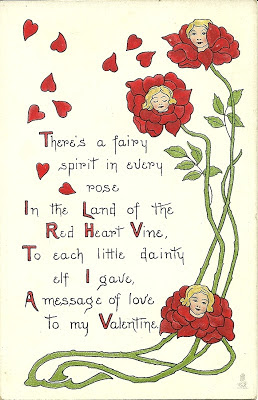
If the Great Poets Wrote Valentine's Day Verse: More Vintage Valentines from P&PC
Emily Dickinson:
Paul Laurence Dunbar:
Wallace Stevens:
Ezra Pound:
Edna St. Vincent Millay:
Gertrude Stein:
William Carlos Williams:
T.S. Eliot
Walt Whitman:
Monday, February 11, 2013
Sunday, February 10, 2013
Sunday, February 3, 2013
"It's hard to keep cool when you talk like a fool": Samantha the Bard & the Poetry of Bewitched
Fans of Joss Whedon's popular teen television drama Buffy the Vampire Slayer often cite Season 6, Episode 7 ("Once More, with Feeling")—in which a demon casts a spell on the town of Sunnydale that compels people to break into song—as evidence of the show's innovation and aesthetic complexity. We here at P&PC aren't gonna pick a fight and disagree with the conventional wisdom of Buffy Studies, but we do think it's worth checking out Season 5, Episode 18 of Bewitched—aired more than thirty years earlier, on January 30, 1969—as a possible precedent if not source of inspiration for Whedon's November 6, 2001 production.
In "Samantha the Bard," which was co-written by the show's creator Sol Saks (see the videos below), Samantha the witch comes down with a virus that makes her speak in nothing but rhyme. Initially misdiagnosed as Venetian Verbal Virus but later identified as Primary Vocabularyitis and mainly presenting in the form of couplets, her rhyming speech causes problems especially at a business dinner where her husband, an ad man, is trying to convince a dog-food manufacturer to adopt a new, more modern campaign that—get this—does not use jingles. We're not going to play spoiler and ruin the episode for you, but, as you watch, it's worth keeping in mind how "Samantha the Bard" not only links poetry with outmoded forms of communication but with disease as well. (And then, if you're taken by the logic of this convergence, go check out Dino Franco Felluga's 2005 book The Perversity of Poetry: Romantic Ideology and the Popular Male Poet of Genius, which explores the links between poetry and sickness in nineteenth-century British poetry.)
Is "Samantha the Bard" a precursor to Whedon's "Once More, with Feeling"? Both episodes have plots centering around a magical female main character. Both pathologize rhyme (spoken or sung) as a disease or curse brought to a community from the outside. Both present rhyme as contagious (at the end of "Samantha the Bard," Samantha's mother comes down with symptoms). And both associate the return to health and normalcy as a desirable return to the prose of everyday life. It's quite possible, of course, that Whedon didn't have "Samantha the Bard" in mind as he was writing "Once More, with Felling," but then again, no one sets out to get sick either. A figure for the workings of literary influence, Samantha's Primary Vocabularyitis may very well have affected Whedon whether he knew it or not. As they say in Bewitched, after all, "There's a lot of it going around."
Thursday, January 24, 2013
Breaking News: Did Richard Blanco Lip-Sync the Inaugural Poem?
In 1961, eighty-six year-old Frost had prepared the poem "Dedication" to deliver at the inauguration of John F. Kennedy. When buffeting winds and the sunlight's glare off the paper and snow made it impossible for him to read, however, the four-time Pulitzer Prize-winner recited another, shorter poem, "The Gift Outright," from memory instead. Although "The Gift Outright" was first published in 1942, Frost's 1961 recitation of it is not only frequently credited with popularizing the poem, but with setting the gold standard for inaugural poems as well.
"I'd understand completely if Blanco did lip-sync it," remarked a fellow poet, also citing the Frost scenario and the pressure of reading before such distinguished company. "But I don't think he did."
Cellist Yo-Yo Ma, who cello-synced during Obama's first inauguration in 2009, explained his decision by saying, "You can't play cellos in 25 degrees."
"It would be totally understandable," another spokesperson for the Marine Band said. "You try being Richard Blanco, standing up there as the youngest inaugural poet in history, trying to hold your paper in that type of cold. Paper just doesn't function the same way when the temperature drops to near freezing."
Other poets and critics have been less charitable when hearing the speculation about Blanco's possible simulation, however.
Said one, "Lip-sync? Lip-sync? Would Walt Whitman have lip-synced his barbaric yawp over the rooftops of the world? I think not!"
"Well, I'm not so sure," replied another. "What if it was really bad weather? Can you yawp in 25 degrees?"
Still another stated simply. "I don't know if Blanco lip-synced or not. But one thing I do know for sure is that John Ashbery wouldn't have lip-synced. Allen Ginsberg wouldn't have lip-synced either. Nor would Adrienne Rich. This is what happens when you exclude radical poets and the avant-garde from consideration in events like these. Capitalism takes over, poets are turned into mouthpieces for ideology, and poetry becomes a simulation of itself if not a simulation of a simulation!"
This is not the first time that lip-syncing charges have been leveled at an inaugural poet. When Maya Angelou read "On the Pulse of Morning" at the inauguration of Bill Clinton in 1993, some viewers reported a disconnect between Angelou's physical presence and the words they heard.
"I swear," said one commentator. "It looked like Angelou stopped speaking altogether, but the words just kept coming. I don't know how to explain it other than to say she was lip-syncing."
"I totally agree," said another who was in attendance. "But I just thought she'd been elevated to a higher level of being and had become an oracle that no longer needed the body as a medium to speak through. The poem just seemed to come straight from her soul. I have to say, though, the whole Beyonce thing has me thinking twice about it."
An inaugural poem historian acknowledged such conflicting experiences from 1993. "For some people," she explained, "Angelou's performance was nearly transcendent. But for others it was simply, as one of my peer reviewers once put it, 'the Maya Ange-low point' of inaugural verse."
Another scholar suggests that focusing too narrowly on the controversy of lip-syncing in inaugural poems distracts from the longer historical engagement between poetry and lip-syncing more generally, which has its canonical roots in the early twentieth century. According to him, the earliest manuscript versions of Wallace Stevens's famous poem "Sunday Morning" reference lip-syncing.
"If you look closely at the manuscripts done by the youthful Stevens," he explains, "You'll see that the poem's final two lines don't in fact read 'Ambiguous undulations as they sink, / Downward to darkness, on extended wings,' as they do in final manuscript versions, but, rather, 'Ambiguous undulations as they sync, / Downward to darkness, on extended wings.' Stevens is very clearly tying the mystical earthly spirituality of the pigeons, which imitate but not entirely replicate the holy figure of the dove, to practices like lip-syncing. For if we're honest with ourselves, when it comes to matters of faith and belief, all most of us can ever do is mouth the words."
As of yet, Blanco has made no public statement about whether "One Today" was pre- recorded and lip-synced or delivered live this past Monday. Nor has he commented on his relationship to the history of lip-syncing in American poetry. Nevertheless, that has not prevented some readers for scouring the poem itself for clues.
"Obviously," one poet remarked, "the line 'without prejudice, as these words break from my lips' is meant to signal the live delivery of the poem, with the presence of the poet's words troping the immediacy of the national moment to which all are summoned 'without prejudice,' as it were."
"Au contraire," another suggested, "That's the irony that makes Blanco's work so political. When Blanco the poet is lip-syncing that line and the words really aren't breaking from his lips, the performance undercuts the text and implies that the wind carrying those words is not doing so without prejudice, but with the prejudice that Blanco, as an immigrant, Latin@, and gay man has undoubtedly experienced in the U.S."
"I doubt," he concluded, "that John Ashbery could have done any better."
Subscribe to:
Posts (Atom)