Monday, July 22, 2013

P&PC in NYC

P&PC just got back from a fantastic two-week stay in New York City. We rented an apartment in Windsor Terrace, Brooklyn, just across the street from Prospect Park and around the corner from friends living in the trendier and spendier Park Slope. With that as home base, we spent our time visiting, sightseeing, and eating with old friends, taking in museums (The Met, Whitney, and MOMA's PS1), seeing a Broadway show, going to a Yankees game, attending several concerts in Prospect Park including the New York Philharmonic, hitting some flea markets, and sampling what NY had to offer in the way of summertime brews. We hit all five boroughs, had great Puerto Rican food in the East Village, superb Shanghai-style dumplings in Chinatown, mouth-watering Jamaican food in Lefferts Gardens and the Bronx, and walked ourselves out of a new pair of shoes and nearly into a case of plantar fasciitis.

With the exception of a quick dash (that's us—dashing as always—pictured above) into the Public Library to check out and photograph old issues of Popular Poetry magazine (pictured here), we didn't set out to do much in the way of research. But, as always, the research came to us. Is it possible that New York is the city most saturated with poetry in America? Check out the following photos and make the call for yourself.

New York loves Emma Lazarus's 1883 poem "The New Colossus," and while the closest we could get to Liberty Island—where the poem appears on the base of the Statue of Liberty—was the Staten Island Ferry, we did walk past the Park Avenue Methodist Church on the Upper East Side, which is currently quoting the poem's most famous passage "Give me your tired, your poor, / your huddled masses yearning to breathe free" on the sign outside its door.

We also ran across a facsimile of the poem at the City Reliquary, where it's part of a Statue of Liberty display featuring probably more than a hundred kitschy souvenir versions of the Statue. If you haven't been to the quirky, eclectic, three-room museum in Williamsburg, make time in your schedule the next time you go hipster-spotting. There you'll find displays on the 1939 and 1964 World's Fairs, a famous New York barber (along with a photograph album of people whose hair he cut), the dancer Little Egypt who scandalized crowds at the Columbian Exposition, rocks and discarded chunks of buildings from around the city (like a cobblestone from Cobble Hill), and other curiosities curated with a reckless abandon. If you're as lucky as we were, you might even run into a taxi driver-poet.

We, however, didn't take any taxis, preferring to spend our limited allowance otherwise. Instead, we took the subway—one site of the well-known Poetry in Motion initiative coordinated by the Poetry Society of America. Not only are there poem-posters in select subway cars (we kept running into Mary Ruefle's "Voyager" on the F train), but some MetroCards have poems printed on back as well. (The one pictured here was saved for us by our friends in Park Slope.) We have to confess that, more than once on our underground trips around the city, you could have heard us reciting Ezra Pound's "In a Station of the Metro"—a fact that bewildered one of our friend's children who didn't so much as bat an eye when a South American pan flute band stepped on at one station, launched into a short vigorous performance, and departed at the next.

We also did a lot of cool-hunting—not because we're hipsters, but because the weather was hot and muggy, soaring at times into the mid-90s. And even there, the poetry led the way, as this board propped outside of the Bowery Coffee suggests:

We Can Cool You Down,
Get Rid of Your Frown,
And Give You A Smile
That Will Last A While.

Cool-hunting also led us to the Brooklyn Botanic Garden, where we took in the bonzai tree museum and wandered the shady grounds. There, we came across the building pictured to the left which welcomes visitors with two lines mounted above the front door:

He is happiest who hath power
To gather wisdom from a flower

In case you were wondering, the lines are by Mary Howitt (1799-1888), a British writer and translator who, according to Wiki, authored over 100 books by herself and with her husband.

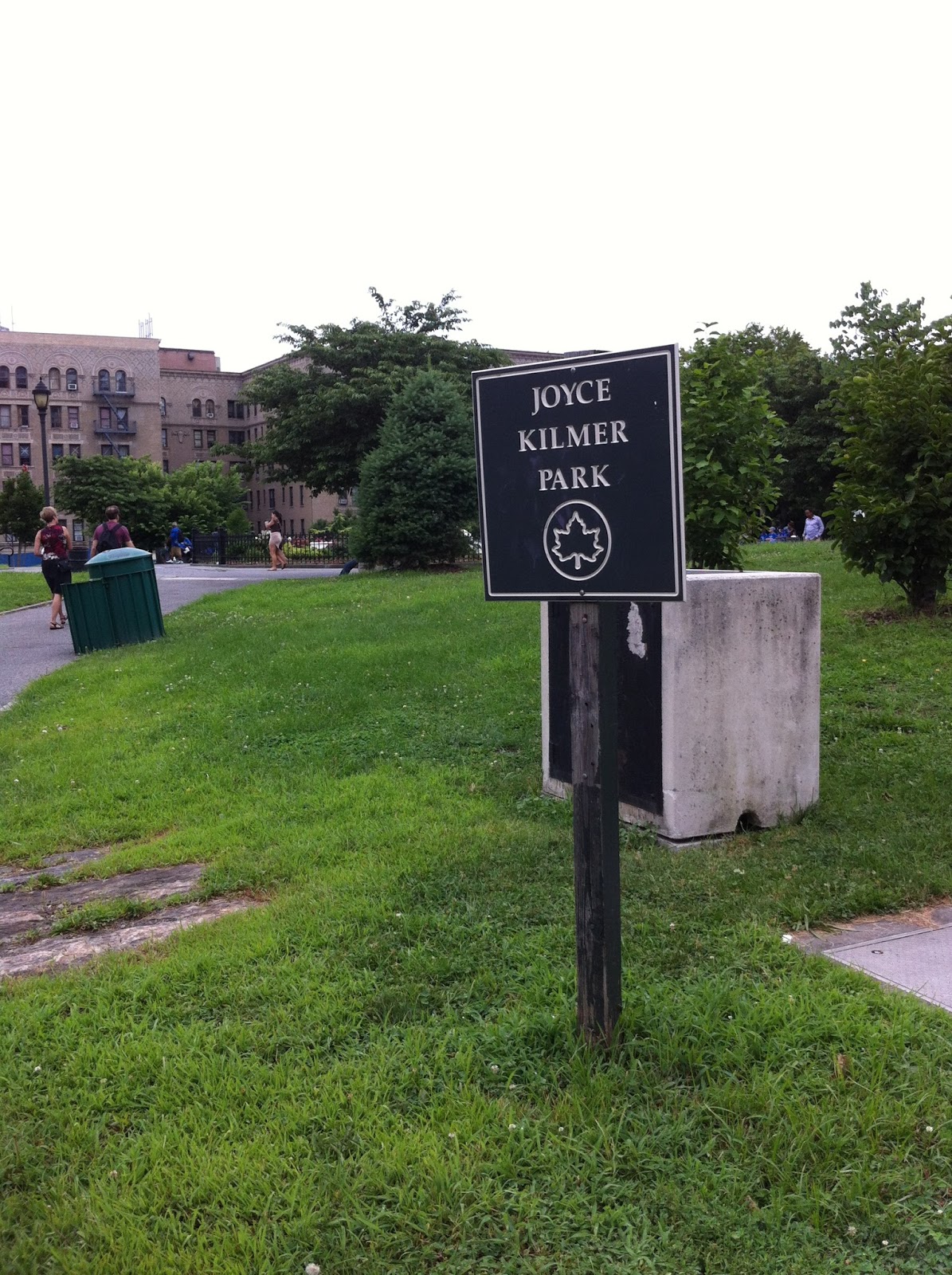
We're no fans of the Yankees, but we're fans of baseball, and so we took in a game at the new Yankee Stadium, stopping beforehand at Fauzia's Heavenly Delights food cart and taking our lunch to eat in Joyce Kilmer Park—named for the World War One-Era American poet, New Jersey native, and onetime Columbia College student. We searched and searched, and while we found a statue of Bronx civic leader Louis J. Heintz (as well as a rat nibbling on french fries and popcorn someone had strewn about), we couldn't find so much as a plaque about Kilmer himself. For a moment we wondered if the leaf design on the sign were a tribute to his famous poem "Trees"—a distillation of the poem to a single image—but then we realized with some dismay that, nope, it's just the logo used by the City of New York Parks & Recreation Department. Damn. The Yankees won as well.

So that's a recap of our time in the Big Apple. We walked the Brooklyn Bridge while quoting Hart Crane. We talked about Whitman with a guy running a flea market stall. And we began reading Catherine Robson's great new book Heart Beats: Everyday Life and the Memorized Poem. We've only been back in Oregon a week, but already our memories are fading—like the faces in a New York subway crowd, perhaps, or like petals on a wet, black bough.

Friday, July 12, 2013

P&PC at Five Years Old

There are streamers hanging from the walls, and silver helium balloons are floating around the P&PC Office today. The interns have their glittery, pointy birthday hats on, the entire P&PC Board of Directors is on hand strutting around with their hands in their vests like they've been the ones to make it all happen, and folks whose jobs have been outsourced or who have otherwise moved on to bigger and better things have come back to town. There's Polly the Paper Shredder. And there's Carl the Copy Guy. And is that really Sally the Stenographer? We love the new look. 

Today, P&PC turns five years old.

Who would've thought, back in 2008 when P&PC started up in Iowa City, that—more than 300 postings later—we'd still be around in 2013? That we'd bring on interns and a bunch of puffed-up suits to serve as our Board of Directors? That we'd move home offices from Iowa to Oregon? That more than 142,000 unique visitors would have found us on the inter-webs? That our most popular postings would be about zombie haiku and the poetry of G.I. Jane, The Expendables, The Grey, geocaching, and Craigslist. Back then, we were "just a blog"; today, doing pretty much the same thing we were doing five years ago, we are sometimes cited as an example of "digital humanities" in action. We've gotten shout outs in dissertations and the London Review of Books. We've been approached by fans at conferences. And we've reminded people that Everyday Reading: Poetry and Popular Culture in Modern America is available for 30% off the cover price if you use the coupon code EVECHA when ordering straight from Columbia University Press.

And when we say "we," we so mean it. Over the past half decade, twenty-two people—twenty-two!—interested in the intersection of poetry and popular culture have contributed guest postings, oftentimes more than once. (Shout outs to Melissa Girard, Catherine Keyser, Jeff Charis-Carlson, Jeff Swenson, Angela Sorby, Erin Kappeler, Jim Sullivan, Eric Conrad, Colleen Coyne, Ce Rosenow, Phil Metres, Liz Jones-Dilworth, Adam Bradford, Brian Greggs, Sarah Ehlers, Loren Glass, Drew Duncan, Nadia Nurhussein, Kirsten Bartholomew Ortega, Rachel Dacus, Steve Healey, and Mike Butterworth.) And we've done interviews with another fourteen people working deliberately or maybe not so deliberately in the realm of popular poultry: Stephanie Renfrow of NASA's MAVEN mission, Jim Buckmaster the CEO of Craigslist, Emily Benson of Star-Mark Pet Products, scholar Angela Sorby, John Broderick of the Fisher Poets Gathering, writer Till Gwinn, writer Lewis Turco, Charlie Seemann of the National Cowboy Gathering, writer Ryan Mecum, Tessa Kale of the Columbia-Granger's Index to Poetry, Irving Toast the Poetry Ghost, Mark Davis (son of poet Frank Marshall Davis), and Lucas Bernhart, the one-time poet laureate of the Portland Trail Blazers.

Needless to say, we no longer feel so alone.

It's hard to predict what the next five years of P&PC will bring, but we're not worrying our heads about that just now. Today is about celebrating five years of fun and sending out huge thank-yous to everyone who's helped to make those years possible. Now it's time to go catch up with Carl the Copy Guy, and, of course, go light the candles on our Edgar Guest birthday cake using—what else?—the vintage book of matches (issued by Hallmark) shown in the first three pictures above.

Thursday, June 27, 2013

Whitman's Grandchildren: Becoming and Unbecoming Walt Whitman

The January 2013 issue of PMLA has a pretty cool article ("Whitman's Children") by Bowdoin College English Professor Peter Coviello (pictured here) that takes as its starting point a couple of babies born after the U.S. Civil War that were named Walt—a nominal tribute that two veterans paid to Walt Whitman after receiving Whitman's care during the war. William H. Millis, for example, wrote to Whitman more than a decade after the war to say, "We have not forgotten you & want to hear more from you. We have had a son borned since we heard from you & We call him Walter Whitman Millis in honer to you for Love for you." And in 1868 Benton H. Wilson wrote to tell Whitman that his (Wilson's) once-rocky marriage worked out and that, "My little baby Walt is well & Bright as a new dollar."

This is suggestive, Coviello argues, because while Whitman didn't have any biological children, the pair of baby Walts bearing his name should prompt us to think about the nature of reproduction and parenthood more generally and especially about the model of "queer generation" that Whitman—as a surrogate parent to the men he nursed and as the baby Walts' namesake—might have imagined. During a war that split a nation and its families—pitting North against South and brother against brother—Coviello wonders if Whitman worked in his writing and caregiving to "restore carnality, in its world-making force, to family and especially to parenthood" as a way to produce the future, or to at least "wonder...if a future can be something you parent, with and through sex but not heterosexual reproduction." Embodying the roles of lover, brother, father, mother, uncle and comrade—all roles that meet at the bedside that Whitman so frequently occupied while working as a nurse during the war—Whitman imagined a "sexually saturated sociability" that didn't police human tenderness or caregiving by making desire "the province of one exclusive set of attachments" (like husband and wife), but that instead turned sex into what Coviello calls "a mode of relation." In a time when the nation was "a nuclear family turned violently against itself," he argues, Whitman was after a "recast familial structure" as well as "the prospect of a mode of generation that is sexual, though not quite normatively heterosexual nor normatively reproductive."

As is the case with much of our favorite academic scholarship, we like and admire Coviello's piece a lot but nevertheless wonder how it might shed light on, and/or become more complex via its relationship to, certain aspects of popular culture. When one looks, for example, there are more baby Walts out there than just the real-life sons of Civil War veterans Millis and Wilson. These other Walts are fictional Walts, yes, but Walts that possibly indicate the persistence or reach of Whitman's "queer generation" (at least as realized in the literary or artistic realm). Take, for example, Don Draper, the poetically-simmering advertising executive and lead character of AMC's award-winning television show Mad Men. (That's Draper reading Frank O'Hara's Meditations in an Emergency pictured above; you can watch the scene in which he recites O'Hara's verse in voiceover here.) As fans of the show know, "Don Draper" was not in fact Draper's birth name; it's the name of a soldier shot and killed next to Draper during the Korean War whose identity Draper adopted (or stole) by switching identification papers in hopes of escaping his past. Draper's birth name was—you got it—Dick Whitman. So, even though the real Don Draper died in the war, his name lived on, and the name Dick Whitman went into history as KIA. It's as if Dick Whitman were born one of the baby Walts mentioned in Coviello's article except that, instead of carrying on the Whitman family line, he chose to scrap it (during another war that split another country in half, mind you) in order to do his own act of re-imagining the future.

Coviello works through the range of Walt Whitman's wartime relations by tracing a "dialectics of substitution and supplement" in which Walt appears to comfort patients "by becoming them" and by becoming surrogates for their family members, embracing, in the process, "an unresolving, generative play of identity and difference, or multiplying differences." In Mad Men, though, Don Draper doesn't embrace this play; once (as Dick Whitman) he has committed an initial act of substitution for self-serving purposes ("becoming" Don Draper), he seeks to hide if not repress that act in his endeavor to become the single, stable, coherent identity that he wants to be: successful ad exec, hyper-hetero womanizer, and normative Cold War parent who reproduces in normative heterosexual ways. But the fact is that, even though he was officially KIA, Dick Whitman won't stay hidden (because he's still alive; because he has become Don Draper), and much of Mad Men is a return-of-the-repressed story in which the ghost of his former self comes back to haunt Draper in any number of ways. One might say that Dick Whitman thought he was out-Whitmaning Coviello's Whitman by using Walt's "dialectics of substitution" to escape his identity as Whitman's grandchild in order to become a normative parent, only to then discover that the play of identity and difference that he thought promised him liberation and stability is not a one-time deal but, as Coviello puts it, "unresolving." That lack of resolution in what should have been a stable real life identity eats at Draper and the Cold War America he represents in any number of ongoing ways, and it is soothed only, perhaps, by the writing of poetic advertisements, an act (at least as the show presents it) that entails Draper inhabiting the mindset of, or "becoming," the psychologically wounded American consumer—oftentimes via proximity to Dick Whitman—to whom goods and services will be marketed. Don is most fully himself, that is, when he is simultaneously marketer, consumer, Whitman, and Draper.

Draper's not the only character that popular culture has associated with Walt Whitman, however. There's also Walter White—the high school chemistry teacher turned drug manufacturer in AMC's other award-winning show Breaking Bad. (Given the Whitman connection between them, one can't help but wonder if AMC used the same writers for both.) The connection between Walter White and Walt Whitman is suggested not just by their shared initials and shared first name, but by several moments in the show's plot—one where White's laboratory assistant Gale recites "When I Heard the Learn'd Astronomer" in full (watch it here), and another when Walt deflects the suspicion of his DEA agent brother-in-law by claiming that the initials "WW" on a piece of confiscated paper probably stand for "Walt Whitman" and thus make for a misleading or specious clue in his investigation.

Even though he claims to not know "When I Heard the Learn'd Astronomer," more connects Walter White and Walt Whitman than just their names. Like Whitman and Draper, White assumes a second identity (that of meth cook) during wartime (both the war on drugs and the wars between dealers), and his character revolves around the performance of his multiple identities and especially how those identities affect his status as parent; not only is he a biological father (the economic pressures of his son's physical disability plus an unexpected pregnancy drive him out of the classroom and into the drug trade) portrayed as an artist (also like Whitman and Draper) creating new material all the time, but he is also a surrogate parent for his assistant Jesse Pinkman. In their choice of careers, physical appearance, mentoring relationship, and shared trauma, Walt and Jesse in fact seem more like father and son than Walt and his biological son do. (Ironically, Walt's biological son is named Walter Jr., making him a great-grandchild of Walt Whitman, perhaps). Over the course of the show, Walt is many things—father, friend, lover, uncle, comrade, teacher, and so on, oftentimes playing nurse to the frequently wounded Jesse—in a distinctly Whitman-like way. What is remarkable about this is how Walt feels so much more alive in his non-normative context (away from the nuclear family) than he does at home, and the show's topic of drug addiction is really a trope for how he has become addicted to what we might, following Coviello, call the queer generativity of his other life (the science, the production, the parenting and care-giving roles), so that even when he has a chance to walk away, he can't bring himself to do it; the "carnality" or "world-making force" that Coviello sees in Whitman is too powerful to let him return to heteronormative life. Like Coviello's Whitman "laboring" to create a future for the family and the nation that he one day won't be alive to see, Walter White is also busy trying to make a future he won't be part of—laboring under a cancer diagnosis to provide financial security for his biological family in the event of his death.

If Don Draper of AMC's Mad Men knows that he is a grandchild of Walt Whitman and denies that lineage only to be haunted by it forever after, Walter White of AMC's Breaking Bad doesn't know that he is Whitman's grandchild, but the force of that ancestry propels him into the "unresolving, generative play of identity and difference" that is his birthright and inheritance. Whereas Draper can never fully become an authentic self once he opts out of Family Whitman, White finds himself to be most fully himself in the "multiplicity ... the multitudinousness" of non-normative, carnally-driven identities. One might say that if Walt Whitman comforted others by "becoming them" in a dialectics of substitution and supplement, then Walter White, in becoming Walt Whitman, also becomes himself. That most of this happens in contexts outside the law and hidden from the nuclear family suggests that Whitman's "style of queer world making and queer future making" is what history has oftentimes made queer world making out to be: the source of good stories but ultimately illegal—a criminal act.

We're not totally sold on our overall assessment here—hey, we're busy enjoying cherry and raspberry season in Oregon—but we do think it's pretty interesting that Dick Whitman and Walter White join Walter Whitman Millis and Walt Wilson on the extended Whitman Family Tree, and we'd love to see what Coviello would make of it all and how he might go about bridging the real-life historical Walts and the fictional, contemporary ones imagined by folks at AMC. Can we in fact read the television side of the family as Whitman's children and grand-children—and thus as evidence that the "future for sex" that Coviello says Whitman imagined has in fact come to be (or at least lived on) more than Coviello suggests in his essay? What of Whitman do they (or we) thus inherit, and what has the Whitman family become? And are they, like Allen Ginsberg in "A Supermarket in California," also walking all night through solitary streets dreaming of a lost America of love?

Friday, May 31, 2013

The Rise of Creative Reading: Melissa Girard Reviews Catherine Robson's "Heart Beats: Everyday Life and the Memorized Poem"

Almost immediately after receiving its copy of Catherine Robson's Heart Beats: Everyday Life and the Memorized Poem from Princeton University Press, P&PC sent it back across the country to Melissa Girard (pictured here), a longtime P&PC contributor and intern favorite whose reviews of What Poetry Brings to Business and The Cultural Politics of Slam Poetry continue to be some of the most popular postings in P&PC history. In what follows, Girard—an Assistant Professor of English at Loyola University Maryland whose essays and articles have appeared in the Oxford Handbook of Modern and Contemporary American Poetry, the Journal of Modern Literature, and The Chronicle of Higher Education—uses the publication of Robson's book to wonder, "What are we teaching students when we ask them to memorize and recite poetry? Are our intentions better, different, or purer than our nineteenth-century counterparts?" and "What is the heart beat of twenty-first century poetry?" We here at P&PC heart what she has to say, and we think you will too.

The recent publication of Caroline Kennedy's Poems to Learn by Heart has people talking about the "lost" art of memorizing and reciting poetry. Throughout the nineteenth century, rote learning was a common feature of both American and British classrooms. Anxious schoolboys, eager to please—and, eventually, schoolgirls too—memorized and recited just about everything, not only poems but also Bible passages, speeches, and, indeed, the vast majority of their "lessons." As pedagogies advanced, rote learning fell out of educational favor. By 1920 in Britain and 1950 in the U.S., the practice of memorizing and reciting poems had ceased to be a mandatory or routine aspect of literary study.

In an interview with NPR's Neal Conan, Kennedy says, "'By rote' has sort of a negative connotation. I don't even know why."

Catherine Robson has a very good explanation for Kennedy. In her sweeping, interdisciplinary study, Heart Beats: Everyday Life and the Memorized Poem, Robson charts the rise and fall of this once-dominant pedagogical practice. Heart Beats significantly deepens our understanding of the memorized poem, bringing clarity and rich historical detail to a topic that is often shrouded in a haze of cultural nostalgia.

Heart Beats is a massive undertaking, and it's hard not to be drawn in by the sheer audacity of it. Like Joan Shelley Rubin's Songs of Ourselves: The Uses of Poetry in America, from which Robson borrows heavily in the U.S.-focused portion of her study, Heart Beats offers a bold, new way to think about the meaning and value of poetry. Traditionally, the field of literary studies has been organized around major authors, historical periods, or national geographies. Robson moves fluidly across time and place, following what she calls "the unbroken line" of poetry memorization and recitation, which remained intact from the late eighteenth century through World War I in the U.K. and World War II in the U.S. As Wordsworth gave way to Whitman and the Victorians bowed to the New Woman, generations of schoolchildren remained united by the shared rhythms of recitation. Heart Beats is a new perspective on literary history, experienced through the beating hearts and sweaty palms of poetry's most assiduous readers.

The book is divided into two parts. Part 1 offers an institutional history of the memorized poem in British and American public education, and Part 2 provides three case studies in the memorized poem: Felicia Heman's "Casabianca," Thomas Gray's "Elegy Written in a Country Churchyard," and Charles Wolfe's "Burial of Sir John Moore after Corunna." Each of these poems featured prominently in school recitations in English-speaking countries for much of the nineteenth and twentieth centuries. The Afterword also contains short case studies on Rudyard Kipling's "If-" and William Ernest Henley's "Invictus," which, in recent years, have become national favorites in Britain and America, respectively. (Robson has helped me understand why, every semester, at least one of my students begs me to add "Invictus" to our poetry syllabus.)

This institutional focus, alone, is illustrative: Robson dispels some of the nostalgia surrounding the memorized poem by reminding us that it was once a compulsory classroom exercise. To Kennedy and many contemporary proponents of the practice, memorization and recitation are elective or, at least, extra-curricular pursuits. Robson recounts, for instance, how her mother paid her a penny a line to memorize poems when she was young, and, thanks to inflation, Robson paid a friend's child a pound per line to memorize all forty lines of "Casabianca." Such incentives were unavailable in the nineteenth-century classroom.

In its earliest years, poetry's role in the classroom was strictly instrumental: it served, Robson says, as an "unobjectionable" substitute for Scripture. "For many centuries," Robson writes, "verse played only a facilitating role in the learner's progress towards literacy's official goal and its sole true justification, the reading of the Bible" (41).

By the middle of the nineteenth century, in both Britain and America, poetry began to play a more primary and complex role in the "training" of children. One of the most valuable aspects of Robson's work is that she resists the temptation to generalize about the memorized poem. She shows, instead, how elastic this form has been: as pedagogies, educational technologies, students, and teachers changed, we kept coming back to memorization and recitation. They (and now we) keep falling in and out of love with the memorized poem.

Heart Beats assembles a diverse array of materials that document the contradictory experiences people have had memorizing and reciting poetry at school. Robson draws on textbooks, teacher training manuals, educational history and philosophy, students' journals and memoirs, and even classic fictional accounts of memorization and recitation like those in Vanity Fair, David Copperfield, The Adventures of Tom Sawyer, and Buddenbrooks. These historical materials will be of significant interest to literary scholars, as well as those interested in the history of reading and the history of English education.

Some, like Caroline Kennedy, relish the triumph of learning by heart—of internalizing a poem and making it your own forever. In her recent The Use and Abuse of Literature, Marjorie Garber recounts how we used to speak of someone "having" literature. Samuel Johnson, for instance, said of Milton, "He had probably more than common literature." Johnson doesn't say that Milton wrote great literature, Garber emphasizes, but that he possessed it.

This is not so different from Anne Treneer, a former "scholarship girl" who became a teacher and went on to teach memorization and recitation in her classroom. In her autobiography, School House in the Wind, Treneer remarks, "A child said to me once that she liked poetry because she liked the taste of the nice words in her mouth" (qtd. in Robson 165). Interestingly, Robson argues that positive feelings about the memorized poem are more common in the U.S. than Britain. The two countries have experienced the memorized poem in "nationally distinct fashions," Robson claims, because of unique educational histories, class structures, and the ideology of individualism (234). It is perhaps appropriate, then, that Kennedy—the solitary scion of Camelot—should serve as the current ambassador for the memorized poem in the U.S.

Robson's evocative case study of "Casabianca," a version of which appeared previously in PMLA, is especially sensitive to the aesthetic, bodily pleasures of poetry recitation. Robson writes, "When we do not learn by heart, the heart does not feel the rhythms of poetry as echoes or variations of its own insistent beat. We contemporary readers no longer hold poems with regular iambic rhythms at our core" (96). This is one of Robson's key insights about our changing relationship to poetry. When we look back on the nineteenth century, Robson says, it's not that difficult to relate to Victorians' love affair with the novel. We, too, enjoy "satisfyingly fat books" as a form of leisure, an indulgent retreat from our carefully measured working lives (113). However, our connection to nineteenth-century poetry reading (and, hence, readers) is more tenuous:
When we read poetry ... there are few lines connecting us to the memorizing population long ago. Because that particular technology of dissemination fell out of pedagogical favor, we now find it hard to appreciate the special relationship between body and poem that was created by a highly structured set of circumstances. (113) 
"Casabianca," like so many of the poems of the past, felt and meant something different to generations of readers who held its persistent iambic beat, "ti-dum ti-dum," in their "deep heart's core."

Before we get too nostalgic, though, it's worth remembering: we never "lost" or "forgot" the memorized poem. For a variety of complex pedagogical, aesthetic, and political reasons, we—that is, the discipline of English, the field of literary studies, English educators, literary critics, poets, and parents—abandoned it. At least as early as Emerson, thoughtful people, poetry lovers, and committed educators had serious reservations about an institution that practiced students in the art of submission. In "The American Scholar" (1837), Emerson argued against rote memorization and for what he called "creative reading." "One must be an inventor to read well," Emerson writes, and schools, he says, can only serve us "when they aim not to drill, but to create."

At the end of the century, in his "Self-Realization as the Moral Ideal" (1893), John Dewey made a similar argument on behalf of "active" or "volitional" education. Self-realization, Dewey said, "cannot lie in the subordination of self to any law outside itself." Even Ezra Pound, no champion of democracy, to be sure, concurred. As part of his famous break with the metronome of nineteenth-century verse, Pound also argued for an active, engaged educational method. "Real education must ultimately be limited to men who INSIST on knowing, the rest is mere sheep-herding," Pound writes in his ABC of Reading (84, screaming in all caps original).

For those harboring a romanticized notion of nineteenth-century schoolrooms, of students soaring freely on the "blithe spirit" of poetry, Robson reminds us that rote learning was also a powerful tool of indoctrination. Here, she builds on Angela Sorby's work in Schoolroom Poets: Reading, Recitation, and Childhood in America, 1865-1917, which shows how the recited poem helped to strengthen a culture of the school and nation.

Many students, in fact, didn't even know what the words they were repeating meant; they recited mindlessly, joylessly, desperately. For instance, Richard Rodriguez, a Mexican American "scholarship boy" who attended Berkeley, Stanford, and Columbia, and won a Fulbright fellowship to study English literature in London, has been a harsh critic of the way memorization indoctrinates working class and minority students in particular. In his autobiography, The Hunger of Memory, Rodriguez recounts how he would memorize literature compulsively "to fill the hollow within me and make me feel educated" (qtd. in Robson 184). Dutifully internalizing the words of an English aristocratic canon, Rodriguez grew increasingly alienated from his cultural roots, anxious and displaced.

In her remarkable case study on Gray's "Elegy," Robson places Rodriguez's disillusionment alongside the rage of other scholarship boys (Raymond Williams and Tony Harrison make appearances too), all of whom felt acutely the class dynamics at play in classroom recitations. Gray's famous lines acquired new significance in the minds and mouths of working class students:
Let not ambition mock their useful toil,
Their homely joys, and destiny obscure;
Nor Grandeur hear with a disdainful smile
The short and simple annals of the poor.
The words of the poem were eventually read and recited by the very "mute inglorious Miltons" that it had rendered silent and unstoried. "Arguably, the twentieth-century grammar school ended up teaching its free-place students more about class than about classics," Robson writes (156).

Today, we tend to think of poetry as a creative, individual, expressive form. Kennedy, for instance, claims that memorization and recitation are creative acts. "When I was growing up, the emphasis was on imitating the style of literary masters," Kennedy writes. "By contrast, today's students are more likely to write about their own lives and challenges" (Poems To Learn By Heart 13).

But Robson's rich, provocative study should make us a bit more skeptical about the creative promise of the memorized poem. (How did I not notice, until now, that Kennedy's Poems To Learn By Heart is published by Disney Press?) I keep thinking about Kamau Brathwaite and all the Caribbean poets he said couldn't get the snow out of their poetry. Part of the experience of colonialism, according to Brathwaite, is a forced poetics—for him, the artificial heart beat of the English iamb. "The hurricane does not roar in pentameter," Brathwaite famously writes.

Robson does not dwell long on the possibility of reinstituting the memorized poem. But, as I read Heart Beats, I found myself wondering if the time is not already upon us. This year, 375,000 American high school students participated in Poetry Out Loud, the national recitation contest sponsored by the National Endowment for the Arts and the Poetry Foundation. This dynamic, extra-curricular arts program hardly seems like "sheep-herding."

But is it an act of creative reading? What are we teaching students when we ask them to memorize and recite poetry? Are our intentions better, different, or purer than our nineteenth-century counterparts? Are our institutions?

What is the heart beat of twenty-first century poetry?

Tuesday, May 21, 2013

P&PC Heroes: An Interview with Stephanie Renfrow of NASA's MAVEN mission

Earlier this month, P&PC was sent, well, over the moon upon learning that one of the programs in the "Going to Mars" public outreach efforts surrounding NASA's MAVEN Mars orbiter mission is a haiku-writing contest. Yep. You, too, earthling, are invited to compose and submit a "message to Mars" in haiku form, and the three most popular entries as determined by online voting will be burned onto a DVD and then shot into space. How popular an initiative has this been? Well, as of the time of this posting—barely three weeks into the contest and well before the deadline of July 1—nearly 11,000 submissions have been received.

Starstruck by the thought of so many people doing more than just looking up in perfect silence at the stars, we turned our telescopes on new P&PC hero Stephanie Renfrow (pictured here), the Education and Public Outreach lead for the MAVEN mission and the brains behind the haiku-writing contest. Renfrow, who has an MA in Science Writing from Johns Hopkins and a BA in English with a creative writing focus from Middlebury College, works at the University of Colorado's Laboratory for Atmospheric and Space Science, home of the MAVEN Principle Investigator. There, knowing full well, as Ray Bradbury once remarked, that "it's not going to do any good to land on Mars if we're stupid," Renfrow supports the mission's work by creating and implementing teacher development workshops, K-12 curricula, summer youth camps, and other outreach programs. Here's what she had to tell P&PC about sending poetry into space.

Poetry & Popular Culture: Poetry on a spacecraft? Far out. How did the idea come about?

Stephanie Renfrow: As Education and Public Outreach lead for the MAVEN mission, I'm always looking for ways to bring the mission into the lives of the public, and I'm especially focused on reaching people who may not usually rub elbows with a space mission. I'm also very interested in using new online technologies to generate communities of interest; crowdsourcing is a powerful way to create a two-way connection. Send-your-name efforts are a long-standing and extremely popular way to get the public onboard—literally—with a mission. But sometimes these efforts can become a one-way street that doesn't necessarily encourage participation: you enter a name, and it flies on the spacecraft. Plus the MAVEN spacecraft is not a lander—we don't have an adorable buggy running about on the surface of a far-away planet, enduring adventures and sending back pictures—so it's not as though names entered onto the DVD aboard MAVEN can be carried around and then left in perpetuity on the surface of Mars. Our DVD will be ephemeral. It will survive only as long as MAVEN survives—for a maximum of about six years, before it enters the atmosphere and burns away.

P&PC: So not exactly "To Infinity and Beyond" ...

SR: True enough! We aren't designing a time capsule for a space mission that will, like Voyager, go out into the universe and explore new frontiers through time while carrying everyone's name along for the ride. The MAVEN mission will explore new frontiers in science.

P&PC: Sorry to interrupt. 

SR: No problem! As I was saying, I wanted to create some way of growing a two-way exchange around the MAVEN send-your-name effort and also generate a thoughtful interaction with the public. I started brainstorming ways to do that; my first idea was to have a student art contest, with submissions by young people put up for public vote to determine the official art for MAVEN and inform the DVD cover's label. Public voting just closed on that effort—with 80,000 votes tallied on 377 inspired entries from young people around the world! My second idea, which led to the haiku contest, was to solicit "messages to Mars"—optional notes that people could submit along with their names. Then, the messages would be voted on by the public to crowdsource the best message in honor of the mission.

P&PC: Why solicit poetry in particular—and original poems rather than famous ones like Walt Whitman's "When I Heard the Learn'd Astronomer"?

SR: Well, the one drawback to my "message to Mars" idea was that it seemed likely that we'd get a lot of less-than-thoughtful responses—you know, "I love Mars" or "Take me with you" or "Hi, Martians." Sometimes, people are at their most creative when they are working within boundaries—just ask a science or engineer tackling a tricky problem developing a space instrument! I wanted to get people thinking about the MAVEN mission, about Mars, about the power of space exploration, about the beauty in our universe. It was a short jump from there to poetry. I also have a personal love for poetry; I especially love the idea that, simply by labeling something a poem—thinking, as you read or write, "This is a poem"—the perception of that slip of writing changes completely. It goes from throw-away words—a text, an email, or a note scribbled on a sticky—to being a statement. Poetry lurks everywhere and in just about everyone. I wanted to bring the thoughtfulness of poetry to MAVEN and offer an opportunity to get regular, not necessarily well-known Earthlings aboard.

P&PC: So, if there's life on another planet, do you think poetry lurks there too? Or is it just an Earthling phenomenon?

SR: "Life" can mean a lot of things. It can mean a tiny microorganism, whose very existence elsewhere in the universe would be, at least in my mind, a kind of poetry. Life can also mean intelligent life—beings whose capabilities meet or surpass humanity's, and whose poetry would perhaps be beyond our ability to comprehend it. Poetry must be everywhere—it certainly is on Planet Earth—but how you define it is an interesting question.

P&PC: Where does your own love for poetry come from?

SR: My fifth grade teacher had us write poetry—she's the one who introduced me to haiku. I started writing then—an entire book of bad poetry by the time I graduated from high school—and never stopped.

P&PC: Why the haiku form?

SR: I did some research on different types of poems. I wanted something short, so people would be more likely to read the poems in the online format. I also wanted something that wouldn't scare people and that would make young people in particular think, "I can do that!"

P&PC: If anyone can submit his or her name to be burned on a DVD that will also be put on the MAVEN, why limit the number of poems to just three?

SR: That was a tough decision. Who knew that we'd already have nearly 11,000 submissions!

P&PC: What's going to happen to the 10,997 that aren't chosen for MAVEN?

SR: The entries that don't win will be online for some unspecified period as an archive of inspiration! And perhaps most importantly, I hope that all 11,000+ people who sat down to write haiku—inexperienced poets and experienced, young poets and old, science-loving poets and new-to-science poets, serious poets and goofy poets—have a spark inside them that they didn't have before. That will be more lasting than anything else about this project.

P&PC: Beyond the sheer number of submissions, what's the public response to the contest been like?

SR: The response has been beyond anything I expected. As the person talking to the media, I've gotten to hear reporters open up and talk to me about their past lives as poets. A woman wrote to us asking permission to submit a haiku on behalf of her mother, who was an accomplished poet before she passed away. Kids have written us asking how they can become scientists. The experience has reinforced, for me, the positive power of creating connections between human beings.

P&PC: Certainly you yourself must have written a haiku for MAVEN. Care to share?

SR: Of course!
Mars mysterious
Thin sky and water-lined face?
MAVEN on its way.